
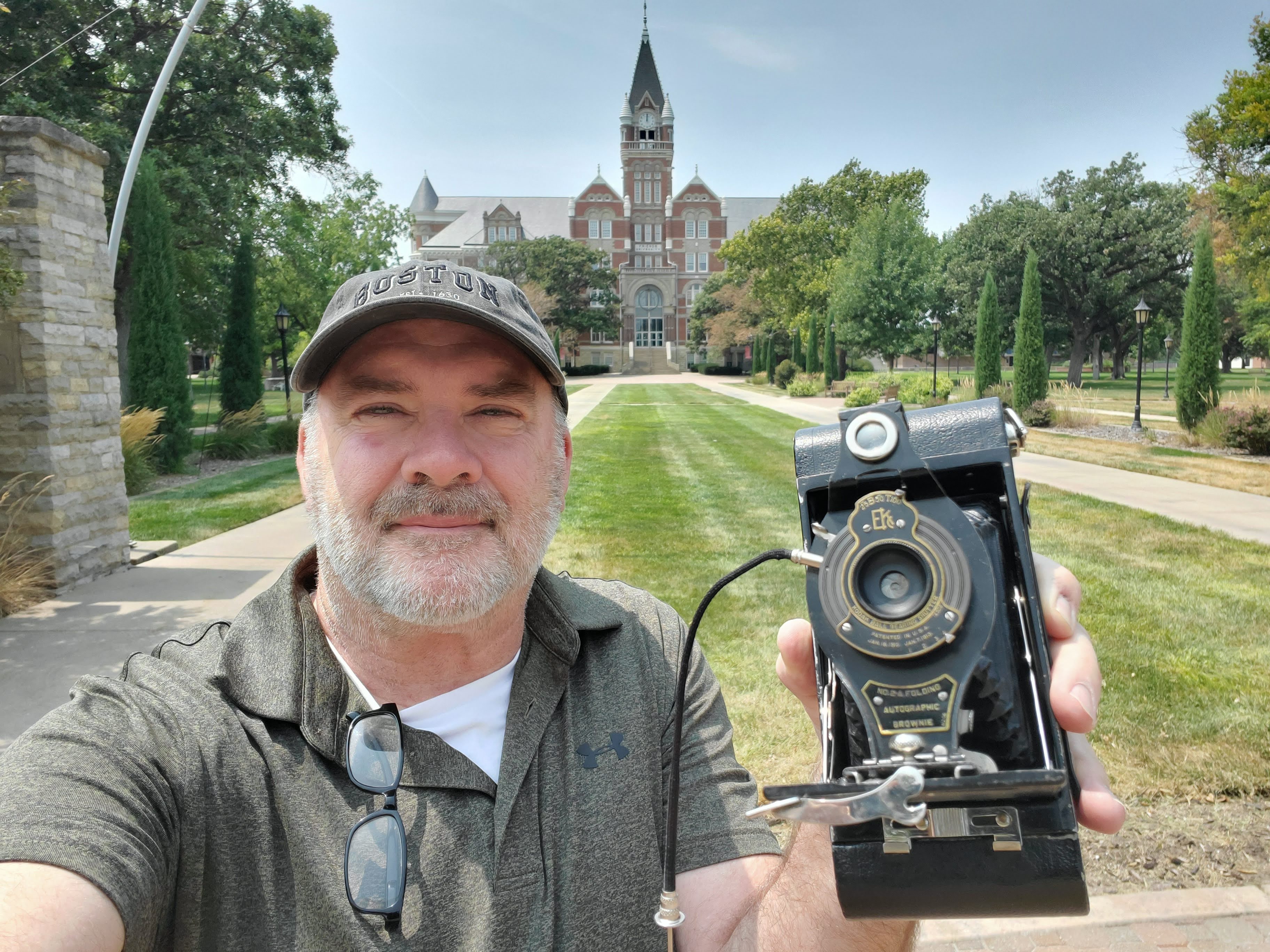
📷 Featured Gear

Some Kansas History
Thomas Oliver Seaton was born on May 30, 1863, in Tennessee. Thomas and his wife Mary had a son, Glenn Otis Seaton. Glenn was born on August 23, 1900, in Prosperity, MO. The Seaton family later relocated to Kansas. A baby girl named Sadie Jessop was born on March 25, 1900 (two months before Glenn) to a different Kansas family.
Thomas died in April, 1916 of unusual circumstances, at least by today’s standards. Thomas had harvested and served frosted rhubarb leaves as a dish of greens for a Saturday evening family meal. The entire household, including Glenn, his mother Mary and a visiting guest consumed the leaves and fell seriously ill. Within a few hours, everyone but Thomas started to recover. Thomas refused to have any medical aid and died three days later. He was only 53 years old. Glenn would have been approaching his 16th birthday.

A few years later, Mary remarried a man named Frank English. Glenn continued to reside with his mother and new stepfather until he was a young man.
Sadie went to school in Otis, KS. She was regularly recognized for perfect attendance and having no tardies. After high school, Sadie moved to Wichita to pursue an education to become a chiropractor. Her family would sometimes travel to Wichita to visit her. She later returned to Otis, KS and set up a chiropractic practice in her home. She also worked with Dr. Lucinda Bates where they officed above Pinkham’s store at 209 N. Cedar in Abilene, KS.

Glenn had also become a chiropractor. It’s not clear if Glenn and Sadie met at school (he also went to Wichita for his studies) or elsewhere. But either way, they did meet. One thing led to another and the two married in July, 1925. The wedding was in Hutchinson, KS and they set up their new home about twenty miles away in Abbyville.
It was while living in Abbyville that Sadie bought a camera. A Kodak No. 2-A Folding Autographic Brownie. The specific camera she bought was made in late 1915 or early 1916. So, the young newlywed likely bought it second hand. She would have been 15 years old when the camera was made.

Brand new versions of her camera sold for $9 to $10 at the time. A used one was probably closer to $4 to $6. The average weekly wage was roughly $24 to $29. While not an extreme luxury, spending the equivalent of an entire day’s wage was a reasonably modest investment for a young couple.
Glenn and Sadie had one son, Keith Leon Seaton. He was born on September 18, 1930. It could also be true that it was his birth, and not the marriage, that prompted Sadie to buy a camera. But what’s almost certain is that Sadie used it to take photos of Keith and her husband.
Glenn and Sadie eventually abandoned their medical careers and started new jobs in education. Chiropractic care was an out-of-pocket expense and it’s likely that during the Great Depression their small community couldn’t support them in their chosen vocation. Besides, Glenn had previous experience by teaching briefly before going into medicine.
Glenn and Sadie were civic minded and socially active. She belonged to the Order of the Eastern Star. Glenn was a Mason. He rose to the position of principal of the Abbyville High School. He was later elected to be the Reno County Superintendent of Public Instruction. He served in that role from 1959 through 1963.
It was right before Glenn’s time as a superintendent that Glenn and Sadie became grandparents. By then, Keith had married Audrey and they had two sons. Randy in 1954, then Mark in 1956.
Sadie died on March 21, 1968. Glenn remarried on September 10, 1969. This wedding was also in Hutchinson. Glenn’s new bride, Ruth, was also a teacher.
Glenn died on November 25, 1980, in Yazoo County, MS. It is probable that he was visiting family for Thanksgiving at the time of his death. His body was brought back to Kansas where he was laid to rest next to Sadie. They are both buried in the Lerado Cemetery, Reno County, Kansas.
In a legal notice after his death, Glenn’s son Keith was officially documented to be the executor of Glenn’s estate. It might have been at this time that Keith took possession of the Kodak camera that Sadie had purchased all those years before. At some point the camera went to Keith’s son, Mark.
Present Day
Fast forward to April, 2026. Mark Seaton had moved with his wife from Hutchinson, KS to Goddard, KS. They wanted to be closer to their children who lived in nearby Wichita. Mark advertised a camera for sale on Facebook Marketplace. It was a Kodak No. 2-A Folding Autographic Brownie with serial number 11206. A check of its serial number shows that it was manufactured in late 1915 or early 1916. The camera was now 110 years old.
I saw the ad and was immediately taken with how pristine it appeared. It was actually a beautiful camera. I met up with Mark in the parking lot of Goddard’s Wal-Mart. After a quick lookover, I gave him $15 for it. I asked him what he knew about the camera and he told me it belonged to his grandfather (or at least that’s what I understood him to say).


When I got home, I messaged Mark for more details about his grandfather. He responded with, “It actually belonged to my grandmother, Sadie Seaton who was married to Glenn Seaton and they lived in Abbyville KS when she bought the camera. My grandfather was principal of high school there and later in life became Reno county superintendent ( which is no longer).”
This small blurb of information was my starting point for the research I did on the Seatons.
Shooting with the Autographic Brownie
The camera itself was designed to use 116 film, which was prominent when the camera was manufactured. 116 film is 70mm wide and this camera produced crazy large negatives of 2 ½ inches by 4 ¼ inches with that film. The “autographic” feature allowed the user to flip open a lid on the back of the camera and use a metal stylus to inscribe information on the back of the negative. Think of it as old school EXIF data. My camera still has its original stylus.
116 film was discontinued in 1980, the same year Glenn died. To use a camera designed for 116 film, modern 120 film can be used. But 120 film isn’t quite as wide as 116 film, so it requires adapters for the camera to accommodate it. It’s easy enough to 3D print adapters, and that’s exactly what I did using PLA filament. The size difference between the two films also means that 120 film doesn’t fully cover the film plane designed for the larger 116 film. This produces negatives a wee bit smaller, measuring 2 ¼ inch by 4 ¼ inch.
Another caveat to using 120 film in place of 116 film is that the numbers on the backing paper of 120 film don’t line up with the window on the back of the camera, which was designed for the numbers on 116 film. This makes winding the film to line up the film for your next shot (with the manual turn crank) less accurate since you can’t rely on exposure numbers lining up in the exposure window.
The camera has only a few shutter speeds to choose from; 1/25th, 1/50th, 1/100th, Bulb and Time. The aperture settings on the camera are simply marked as 1, 2, 3 and 4. The Brownie line of cameras were made with the everyday consumer in mind. Fractional f-stops were considered too confusing for the masses, so they dumbed it down a little. 1 = f/11, 2 = f/16, 3 = f/22 and 4 = f/32.

Focusing is achieved by moving the lens standard forward or back and lining it up with a distance scale. The actual shot is composed by looking through the viewfinder. The viewfinder is a tiny, swiveling box mounted right next to the lens on the front standard. The box contains a mirror set at a 45 degree angle beneath a small magnifying glass which acts as a waist-level viewfinder. The image seen in the viewfinder is laterally reversed from “real life.” This lateral reversal makes panning to track a moving subject surprisingly tricky, requiring you to move the camera in the opposite direction of what your brain expects! The viewfinder can be positioned for both landscape or portrait modes.

The big question about my camera was whether or not it was still functional. I was determined to try. I 3D printed some film adapters then loaded up a roll of Cinestill BwXX. I developed it in D-96, stock solution. I got three images on this roll of film. I should have been able to get six, but like I explained earlier…advancing the film was a guessing game and I overshot how many times to wind the film crank.
The negatives are big, bold and beautiful. The camera works and produced some very nice images.


All three of the Wichita buildings I photographed with Sadie’s camera would have already been built and standing by the time Glenn and Sadie were studying in Wichita.



Leave a Reply