
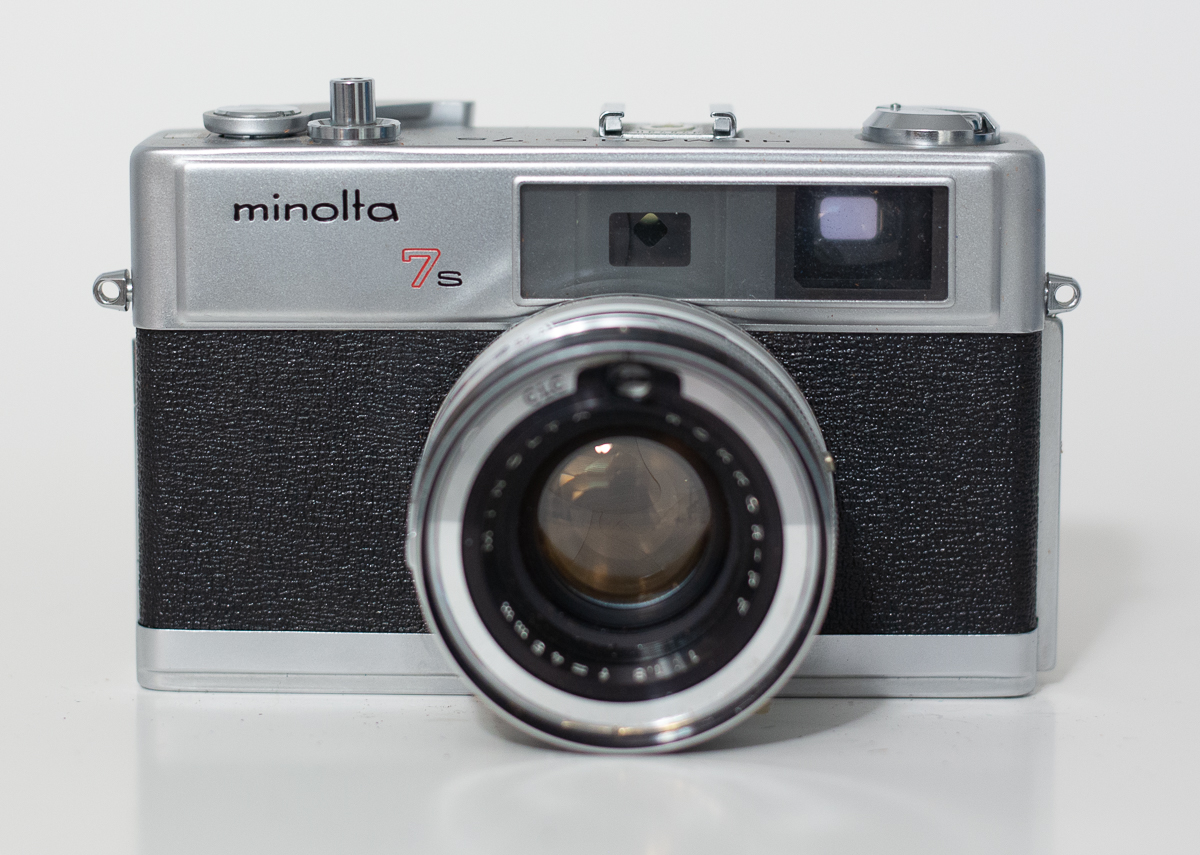
Minolta Hi-Matic 7S

Technical Specifications
| Serial Number | 378730 |
|---|---|
| Film Type | 35mm |
| Shutter | Seiko LA |
| Lens Model | Rokor |
| Lens Specs | 45mm / 1.8 |
| Lens Mount | Fixed |
Notes & History
Historical Context
Released in 1966, the Minolta Hi-Matic 7s is one of the absolute giants of the fixed-lens rangefinder golden era. Made in Japan, it took the baseline success of the earlier Hi-Matic models and added a killer feature: Minolta’s proprietary CLC (Contrast Light Compensator) metering system.
It is a hefty, beautifully constructed all-metal camera that handles like a dream. Unlike later, ultra-compact 70s rangefinders (like the Hi-Matic F or 7sII), the original 7s is a large, substantial body that gives you unrestricted, dual-mode versatility.
The “CLC” mark stamped on the front of the lens bezel stands for Contrast Light Compensator. Instead of a single CdS (cadmium sulfide) cell that averages the whole scene, Minolta split the meter into two separate internal cells connected in series.
One cell read the upper half of the frame and the other read the lower half. If the upper cell detected an incredibly bright sky, the circuit automatically compensated so your foreground subject wouldn’t end up severely underexposed. It was a brilliant precursor to modern matrix metering, all achieved using simple analog electronics.