
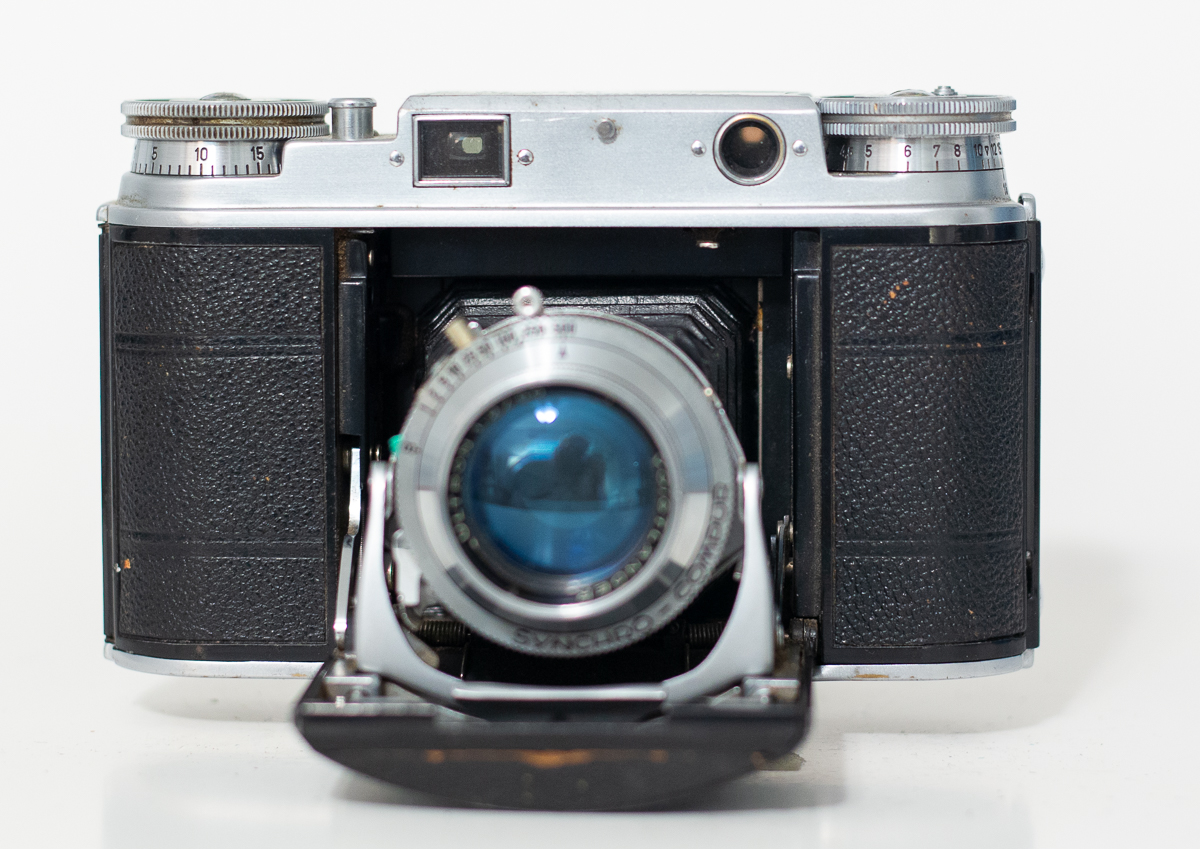
Voightlander Vito III

Technical Specifications
| Film Type | 35mm |
|---|---|
| Shutter | Syncro-Compur |
| Lens Model | Ultron |
| Lens Specs | 50mm / 2 |
| Lens Mount | Fixed |
Notes & History
Historical Context
The Voigtländer Vito III, manufactured in Germany from 1950 to 1954, is a legendary, ultra-premium masterpiece of post-war folding camera design. While the “Vito” nameplate was typically used for Voigtländer’s entry-level, rigid-body consumer cameras, the Vito III was a radical departure. It was essentially a scaled-down, 35mm version of their flagship medium-format Bessa II, creating an uncompromised mechanical jewel that combined the portability of a pocket folding camera with the precision and speed of an elite rangefinder.
The beating heart that defines the Vito III is its magnificent Ultron 50mm f/2 taking lens. Designed by the legendary optical mathematician Dr. Albrecht Wilhelm Tronnier, this 6-element, 5-group gas-molded lens is widely considered one of the finest optics of the 1950s. Unlike standard triplets or Tessar formulas found on lesser folding cameras, the Ultron is highly celebrated for its biting sharpness even when shot wide open at $f/2$, exhibiting magnificent rendering, signature micro-contrast, and smooth out-of-focus bokeh.
Ergonomically, the Vito III stands out from almost every other 35mm camera due to the placement of its focusing mechanism. Rather than a ring on the lens barrel, focusing is controlled via a large, knurled thumbwheel located on the rear left corner of the top plate. This layout allows your left thumb to comfortably dial in critical focus through the bright rangefinder window while your right index finger rests naturally over the top shutter release button.
📷 Photos Taken With This Gear